I had the privilege of being invited to attend a training/competition session of the Toronto Police Services Motor Squad last week. My friend Sean is a motor officer and he obtained clearance for me to be there. It was a two-day event but unfortunately I could only get away for one day. The first day was devoted to team exercises and the second to individuals.

Those who know me know that I’m not much of a “people-person” – I shoot rocks and trees – although if I make the effort… but I’m out of my comfort zone shooting people. These guys made me feel comfortable being there. I chatted with a number of them (and if you’re reading this, guys and gals, I have a real problem remembering names, so forgive me if I meet you somewhere else – not professionally, hopefully – and can’t remember, don’t hold it against me!). They were really nice people, from the Inspectors on down. I’ve been around athletes before, who need to focus, and I did my best not to interrupt anyone’s train of thought.

Physically, they were all different shapes and sizes. TPS Traffic Services comprises some 40 motor officers, a few women, men ranging from fit gung-ho 20-something-year-olds, to wiry grey-haired guys (one fellow told me he’s been “blue-carded” on bikes for 32 years), to, well, a couple of gentlemen who made me feel slim! But they all shared three things in common: (1) they are all police officers, (2) they all REALLY know how to ride motorcycles and (3) they all love what they do for a living.
 |
Pan shot. Slow shutter speed, long lens. When they work... |
I think the team events were more important than the individual skills ones, and here’s why: first of all, they all have the riding skills. If they didn’t, they wouldn’t be there. Sure, some are better than others, but if you spent 12 years like I did teaching basic and intermediate motorcycle skills to civilians, you’d know it in an instant. But here’s the thing: these people are out there every day doing arguably the most dangerous duty a police officer can: individual car stops without a partner (I’m told that “domestics” are up there too). So although they’re out there ostensibly alone, deep down they know that their colleagues always have their backs. They trust each other implicitly. And when they do ride together, they know they can count on each other.

I’m reminded of the Snowbirds demo team where flying in close formation means focusing on your flight leader to the exclusion of everything else (and hoping he doesn’t fly into a mountain!). On bikes it’s the same thing except you also have to be aware of and react instantly to your surroundings. That’s why I called these guys (and gals) athletes.
There’s a sense of camaraderie in the motor squad, familiar to anyone who has ever served in a military unit. And respect and trust for the higher ranks. At this competition, almost all of them were wearing matching athletic shirts that said graphically on the back, “HEAD… and… EYES”. All motorcyclists know what that means. If you don’t, ask one! And they all had a nickname screened on their sleeve! You don’t pick your own nickname, the group chooses it for you! Sean is “RADAR”, for Radar O’Reilly of M*A*S*H fame who somehow could find anything. I met “Keener” and “Turtle” and “Rowdy” and “Scooter” and “Bam-Bam” (don’t want to know where that came from!) and others which of course I forgot.
 |
Serious skills. This is Sean, looking where he wants to go! |
By the way, it was 35°C in the parking lot, and not a cloud in the sky. I was in an athletic shirt (with my old nickname on it: “Gunslinger” — thanks, Radar or “Sheriff” as he used to be known!), a photo vest and cargo shorts: except for the fact these folks were in tee shirts, not dress shirts and body armour, they were all in blue fatigue pants, boots and of course their fully loaded equipment belts. At the end of the day, they had to don their full kits for the ride back to the station: I didn’t envy them. It goes without saying that helmets were mandatory.
I think I understand now why police departments favour the Harley-Davidson over higher performance bikes. The Europeans favour the BMW’s and the Honda ST-1300 and other exotic rides. My old Honda ST-1100 was capable of almost double the top speed of the Harley, it was more manoeuvrable and much less expensive. But if you dropped an ST or a Beemer, into the shop it went for delicate repairs. The Harleys soldiered on. Most of the time you couldn’t even tell if one had fallen over, it landed on the crash guards and even if you did bend some chrome or dent a fender, so what? It’s low and stable and in the hands of a good rider, capable of manoeuvering in tight spaces. That said, the technology is over 100 years old!
 |
Repairing a side stand interlock spring on the fly. You won't see a BMW rider doing that! (Then again, it wouldn't fail on a BMW... LOL ) |
So back to my point of trusting your teammates. There were complex exercises designed to test your ability to do just that — and yet think for yourself. One of them, called the “Dumb Ride” had three bikes in the circuit at a time, inches apart and they changed leaders three times!
 |
I made this out of the shot below, doing a lot of work on the background in Photoshop and using Topaz Glow (see note below this article on the current upgrade available!). |

My only regret is that I didn’t expend more effort to document the team and perhaps get a group picture. It was really, really hot! Sorry. I thoroughly enjoy shooting motorcycles and admiring the skills of these motor cops. Their training is intense and effective, and they’re all really dedicated personable people who do a dangerous job really well. Kudo’s, motor squad.
 |
Here's Sean, doing what he loves! |
New/Updated Topaz Glow
The fine folks at Topaz have just issued an update to their fantastic "GLOW" plugin program, which they have creatively called "GLOW2"! It's on sale from now until September 2nd at 30% off. Here are their words describing the update:
Topaz Glow introduces a new kind of tool into your workflow designed to electrify your imagination by illuminating the contours of your images to reveal the hidden life in each moment you capture. Glow 2 gives you the power to create stunning neon effects, or subtle ethereal glow. No matter the look you love, amplify your images faster than ever with Glow 2.
New features in Glow 2 Include:
- Over 30 New Presets - That brings the total to over 100 included effects to amplify your images or give you a boost creating a personal look you love.
- New Masking Module -You no longer need a host editor like Photoshop to create masks on your images! Now, you can open Glow 2 and mask areas of your image directly from the application using luminosity, color selection, a spot mask, or a traditional brush mask, and yes it’s color aware :)
- Unlimited Undo/Redo - That's right! As long as you don’t close the program you can now undo or redo to your hearts content (as far as your system memory will allow.)
- Topaz Community Integration - Topaz Glow 2 is the 3rd of our products to include the Topaz Community, an easy way for users to search save and share custom made presets with other Glow 2 users around the world. Surf an ocean of hand crafted presets, then download and apply with a click. Or share your custom presets for other users to try.
- Automatic Preset Backup - as long as you’re signed into your account when you save a preset, that preset will be privately uploaded to the community then synced on any other machine you sign into.
There's one caveat: this program uses intense GPU processing, so like Impression 2, your computer must have Windows 7+, Mac OSX 10.9+, and a GPU with OpenGL 3.3 or higher. (this replaces the older requirement for OpenGL 2.1). It won't install if it doesn't detect that. If you already own GLOW, it's a free update. Just download it and install it, it should pick up your existing license key.
If you're a new customer, use the link below and enter the coupon code, "GLOW2" at checkout for the discount. You can also try before buying to make sure it works on your system. Here's the link: http://goo.gl/9dFLLz
The Perseids Meteor Shower
Mother Nature is really cruel. It's been sunny and beautiful here for weeks on end. The peak nights for the Perseids meteor showers were Thursday and Friday. Guess what? Cloudy. I went out on Wednesday night but it was still worth the effort.
 |
No meteors in this shot of the Milky Way. A flashlight, a little light painting... |
Instead of the advertised 150-200 meteors per hour, I saw about 30 or so over two and a half hours. Of course a lot were where the camera wasn't pointing! Still, I managed this composite of about 10 events:
 |
Looking Northeast, I took about 250 frames over about 75 minutes. Each exposure was 15 seconds, with the wide angle lens set at 17mm (full frame), aperture at f/2.8, ISO at 3200. I drove the camera via TriggerTrap, using my iPhone. |
People asked me how I created this composite: I isolated the 10 frames with incidents (I ignored airplanes. How come there are so many planes at 1:00 am in Northern Ontario?). I loaded them as layers in Photoshop and I masked everything except the meteor trail on each layer.
 |
The resulting negative mask looked like this. |
Then I took that composite and laid it over one of the 250 frames.
Since I had some 250 frames, I did two other things with them: I made a video timelapse using Microsoft Movie Maker and here's the link! Click to view it full-screen.
And I also created a star trails composite in StarStax. I didn't like the usual "lighten" type version, so I played with an average-with-increasing-exposure version that was much more subtle and brought out the glow of the Northern Lights that were present but not very visible to the naked eye:
 |
I added in the masked composite from the previous example and did some toning work on the foreground. |
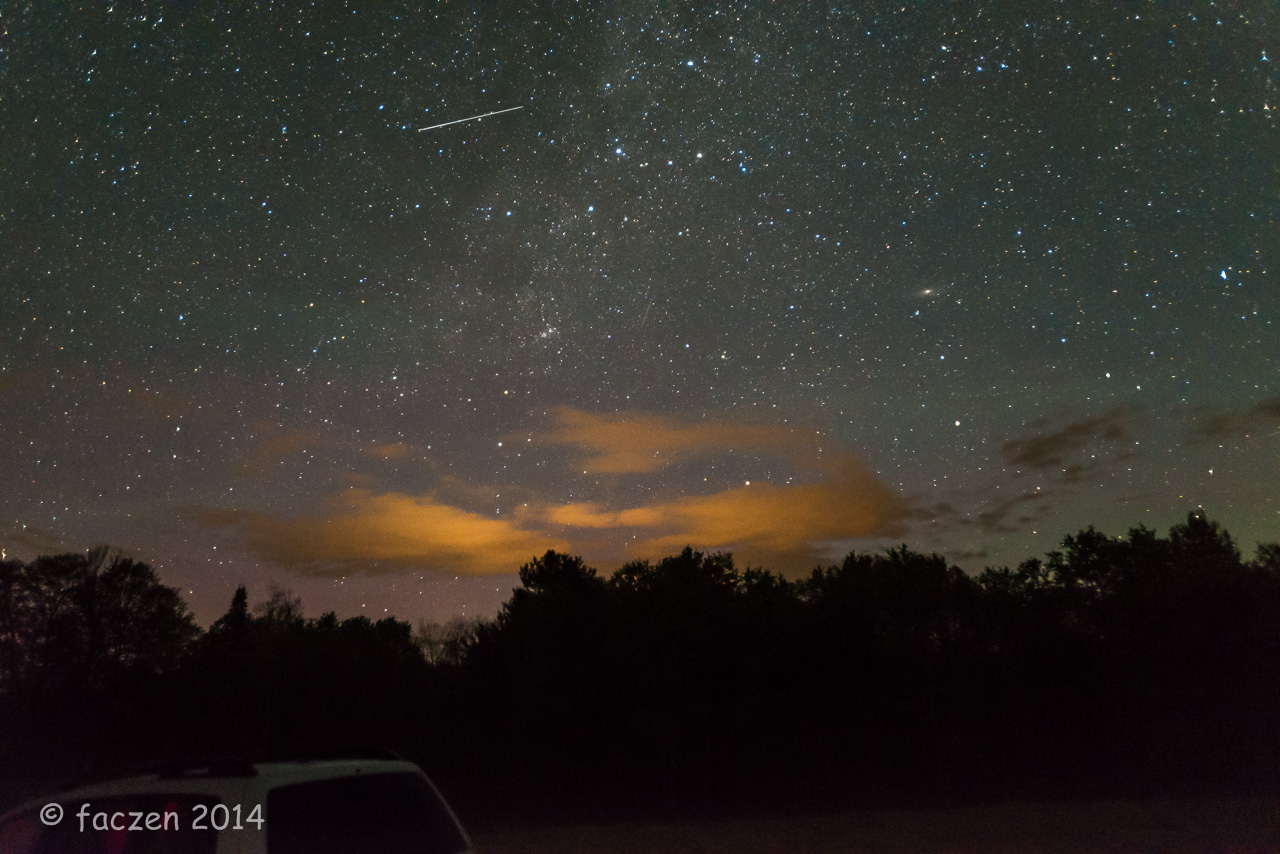
I'll close with another shot of the milky way from a few nights earlier.

— 30 —